A unique cruiser fully restored but needing internal fitting out.
Paper Tiger is a 1963 Bertram 25, she was a successful entrant in the COWES-TORQUAY Powerboat race in the early to mid 60’s and was raced by Charles de Selincourt.
She has been totally restored by current owner and Bertram specialist Ian Saunders to the highest specification. Originally powered by a Mercruiser she now has an economical Yanmar Diesel and like all Bertram’s is an excellent seaboat.
Originally finished in a yellow gel coat she has now been totally refinished using premium quality HEMPEL products in a unique white and ice blue finish.
Paper Tiger is a very attractive, unique and classic 2 berth cruiser which will turn heads in every port.
For full details please contact the vendor on 07771935202 or email [email protected]
]]>This hull is based on the racing prototype and famous powerboat GIOVANNA and built by Halmatic
Nina III – Christina 27 – Available for Restoration
Dimensions - LOA 27 ft – Beam 9 ft 4 in – Draft 2 ft (outdrives up) 3 ft (outdrives down)
Builder - Bruce Campbell (Christina) Ltd – Launched 1974 – Built for Paris Boat Show 1968
Construction - High quality glass fibre deep-vee hull using hollow GRP ribs on close centres and marine ply stringers for high strength offshore capability – Teak decks – Teak and mahogany superstructure with solid teak corners and cappings.
Engines - Twin Chrysler TS3 supercharged diesels, 125 bhp each continuous, 150 bhp intermittent (now no longer functional). Enfield 200H outdrives with electro-hydraulic trim & tilt. Twin 36-gallon GRP diesel tanks.
Max continuous speed 27 knots
Accommodation - 2 permanent berths in fore-cabin; galley; WC with basin; full headroom; enclosed wheelhouse (space for two further permanent berths); large open cockpit
Launching Trolley - Purpose-built, four-wheeled, four docking arms
Current Condition - Now in very poor condition, requiring total restoration. She has been stored onshore for many years, on her launching trolley. The hull is in good condition, but the external woodwork is not. Deck fittings have been removed and are in storage, in good condition. New engines are required. The outdrives are stripped to component level awaiting rebuilding, and are complete with new bearings.

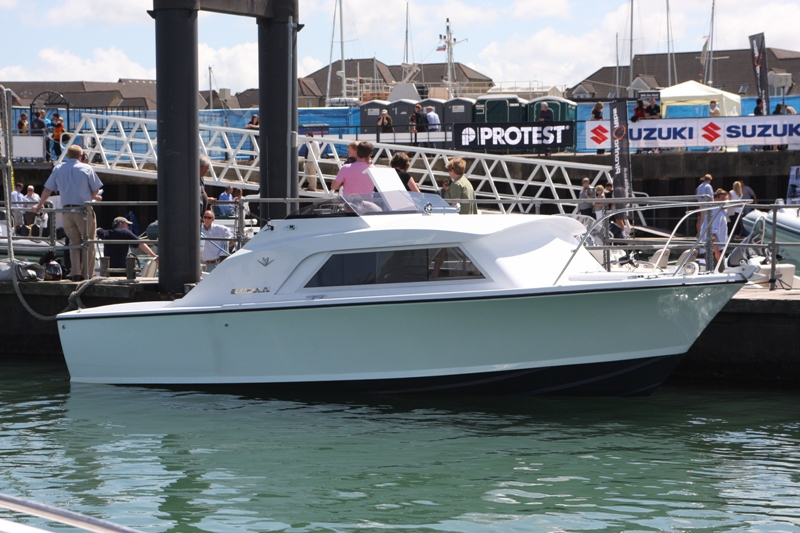
↑ On display on the Bruce Campbell stand at the Paris Boat Show in 1968, without engines. The boat was a bare shell when my father and I bought it in 1970—lovely woodwork but no services or engines. We had a blank canvas.
This outline line drawing was with the very few original documents that came with the boat, when we bought her, part-finished, in Lymington. ↓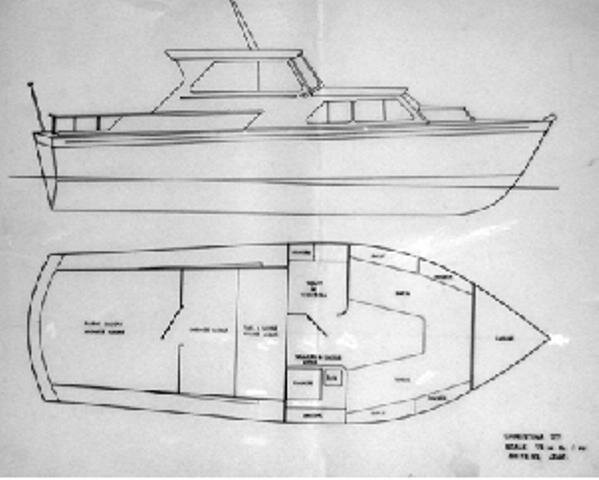

↑ Being craned from the yard where we finished building her, on to the launching trailer.
The deep forefoot of the hull, and the pronounced spray-rails along the bottom, are evident.
First launch in 1971—on the slipway at Littlehampton (at the mouth of the River Arun in Sussex).
At that time she did not have her custom-built launching trolley, and the yard didn’t have a proper boat-lift !
The very pronounced deep-vee hull form, and the two Enfield 200H sterndrives, are clearly visible. ↓

↑ Moored in Brighton Marina, when that was the base for an offshore powerboat race. Nina III made an ideal spectator boat.
Currently in storage onshore on her launching trolley ↓

↑ Internal view of spacious cabin
Enquiries should be sent to: John Hother at [email protected]
or telephone: +44 796 872 6779
In 1961 the first Cowes Torquay Powerboat race featured 4 boats from the Bruce Campbell yard at Hamble they were Thunderbolt no 3 the eventual winner, Christina no 6, Campbell’s own boat Coralie no 4 and Contango A no 5 driven by P.Raymond.

Contango A – 1961
Of those four boats, 2 are missing Coralie and Christina, which was last heard of on the east coast.
Thunderbolt is now fully restored and now Contango A is up for sale.
75% RESTORED she is now looking for a new owner who can complete her revival.
She is a Mark V hull which was redesigned for Campbell by Ray Hunt. The cold moulded hull was built by Walter Lawrence Ltd using the same techniques as they used for the Mosquito fighter plane bodies and finished in Campbell’s yard on the Hamble.
Carrying race no 5 she was originally powered by 2 Palmer engines totalling 270hp then in 1963 with race no 29 was converted to stern drive using the then new and successful Volvo Penta engines totalling 170 hp.
Although she was not as successful as her sister hulls she is still never the less a very important part of the history of this race being one of the very few boats still surviving that raced in 1961.
Current photographs will be supplied soon
Works carried out are as follows:
- Hull stripped and rotten wood replaced where necessary.
- Top half of transom replaced.
- New cabin sides and top.
- New cockpit coamings.
- New capping rails etc in mahogany (varnished but not fitted).
- Hull professionally repainted in original black enamel finish.
- All upholstery re-upholstered in red with white piping.
Specification:
- Twin Volvo AQ145a 4 cylinder petrol engines with 280 legs.
- Long range fuel tanks.
- Separate heads compartment.
- Anchor and chain.
- Fenders.
- Mooring lines.
- Compass and sounder.
- Full spray hood and cockpit cover.
- Four wheel road trailer.
I have not worked on her for four years, and she has been stored under cover (barn) during this time. However the hull was painted two years ago. The engines were turned over last year. The outdrive legs are removed. A new mahogany deck/cover strip for the top of the transom has been made and shaped to fit. She currently looks rather sad, and I will endeavour to smarten her up before any one comes to view. Windows have been stripped ready for re-build. I have the period navigation lights, and also a new set of original engine controls. She also has her original “Blue Book”.
Initial enquiries should be sent to: Richard Rance at [email protected]
Price will be circa £18,000 or sensible offers

Contango A – 1961… notice RAFYC pennant…
]]>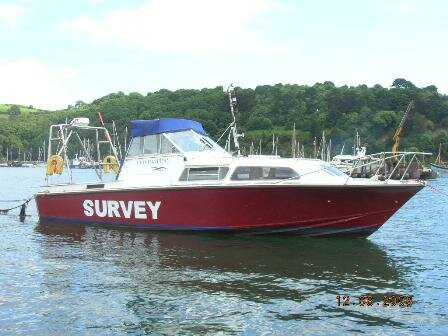
GRASSHOPPER – 12.06.2008
Originally built in 1969 for the Finance Director of Souters Cowes using the famous Souter cold moulding process she is obviously a Ray Hunt design and appears in hull profile to be a smaller version of Sir Max Aitkens “Gypsy Girl”.
She was originally fitted with twin petrols for entry into the Cowes Torquay, although we can find no trace of this actually happening.
Grasshopper is a superb looking craft and when the present owners re engined her they found that she had also been lengthened by another 3 feet from the original by the first owner, intriguing !
Specification to follow
But includes;
- Accommodation for 4 to 6 persons
- 2x Sabre diesels
- useable straight away or can be modernised to suit
CIRCA £15,000.00
A superb Souter built craft with pedigree ideal for Classic events.
Please send your enquiries to: [email protected]
]]>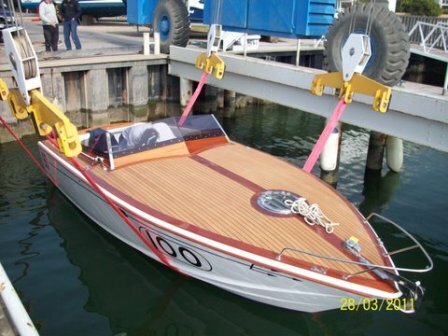
One of the most significant powerboat designs of the early 60’s
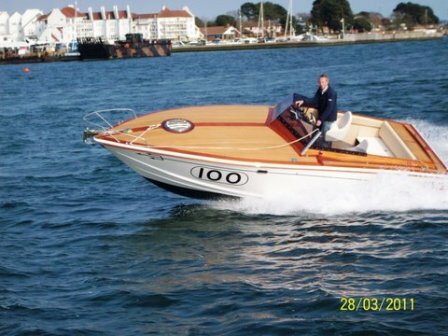
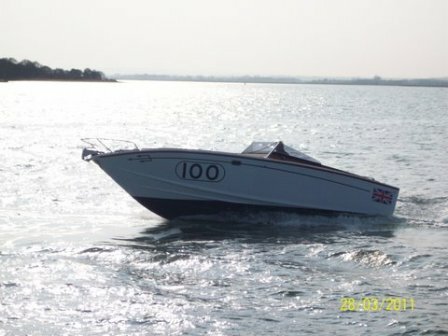
The Levi designed R and W Clarke built “VIVA TRIDANTE”
The craft has been totally restored to the highest specification over the past 4 years and looks absolutely stunning in her original race livery. One of only 5 built and one of the few surviving craft actually useable.
Please contact the owner Ian Wright via email at [email protected]
07788 140997
]]>In 1903 John Thornycroft entered the first running of the Harmsworth Trophy and the Yachtsman’s Cup Handicap Race for auto-boats in his cedar planked on an American elm frame, boat Scolopendra, named after, some say, a fictitious sea monster. She had a turtle-back foredeck and pine planked deck aft, covered with a serge canvas. The relatively low powered but efficient running 800kg boat had been entered as a substitute, when the forty footer being built especially for the contest was not ‘race ready’ (this boat may have also been named Scolopendra).
Thornycroft & Co were established builders of steam cars, commercial and military road vehicles, at Basingstoke; and steel torpedo boats for various foreign navies, at their Chiswick Yard on the Thames. Back in 1873, John Thornycroft produced one of the first motor torpedo boats, the steam powered, 458 hp, Gitana and she achieved 24 mph. Four years later, in 1877, Thornycroft took out several patents for skimming semi-displacement hulls, and for a revolutionary semi-submerged propeller.

The ‘British International’ Harmsworth Trophy
The Automobile Club of Great Britain and Ireland, and its offshoot, the Marine Motor Association planned to manage a race of auto-boats for a magnificent new prize, the Harmsworth Trophy. The race was to be run along similar lines and rules as automobile racing’s Gordon Bennett Cup, whose rules and conditions were in turn duplicated from sailing’s America’s Cup. The aim of all three trophies was that the contest should be a test of nations rather than individuals, and that the vehicles used should be constructed in the represented nation. The inaugural 1903 Harmsworth auto-boat race was held in Southern Ireland, as a new dimension to the auto-car Gordon Bennett Cup race program.
S F Edge and the Napier race team were the current holders of the Gordon Bennett Cup, ‘the greatest automobile race in the World’. The defence should have been hosted in England, by the defending nation, but the government’s enforced ban of speed, in excess of 10mph, on the public highway, precluded the possibility. The Automobile Club decided to switch the races’ venue to Ireland. Edge entered a boat named after its engine Napier. The canoe-stern craft was painted in the new British Napier Gordon Bennett Racing Team colour of dark green, this colour was chosen by Edge, as ‘a tribute to the Emerald Isle’, the race hosts. The phrase ‘British Racing Green’ and the expression ‘Gordon Bennett!’ (Synonymous with surprise), subsequently became a part of every day language for subsequent generations of speed freaks. The Harmsworth Trophy has proved to be the longest standing competition for high speed motorboats.
The first HarmsworthTrophy Races 1903
1st Heat. Three o’clock, Saturday 12 July at The Battery of the Royal Cork Yacht Club, Queenstown Road, Ireland. The course was 10.3 miles, one way, up-stream, passing through the West Passage, with Black and Marino Points to starboard, to a large crowd waiting on the Promenade Quay, at the Cork Marina finish line, on the River Lee. There was a two knot flood tide flowing upstream. The start cannon banged and the two boat standing start was between Durandel and Napier. Durandel went into the lead. Napier showed her pace in the calming up-river water and went through to win by 3 minutes; Beadle’s Durandel completed the course well within the maximum fifty minute qualifying time.
2nd Heat. At quarter past three, Saturday 12 July. Due to the German entry Mercedes not being deemed eligible (due to running a French hull with a German motor) it was Thornycroft’s turn to qualify in Scolopendra, racing against the clock, on her own. If the qualifying 13 mph minimum speed was beaten a place in the Final was guaranteed. She succeeded.
3rd Final Heat. At twenty minutes to five, Saturday 12 July. It was high water and the stream now slack. Soon after the start, the Thornycroft launch, Scolopendra went into the lead. Napier had Alfred Harmsworth’s close friend, Campbell Muir, at the helm, and also on board was S F Edge’s close friend, professional chauffeuse, and the Womens’ World Land Speed Record holder, Miss Dorothy Levitt along with owner ‘SF’ in control of the engine. They soon passed the leading Thornycroft boat Scolopendra. Napier soon showed her superiority and went on to win at an average speed of 24.98 mph, crossing the line, more than a mile ahead of the competition, in a time of 24m 44s. In second place came Scolopendra in 30m 28s (20.28mph) and third Beadle’s Durandel in 37m 44s (16.37mph).
After the running of the Harmsworth race a handicap race for a cup donated by the proprietor of the Yachtsman magazine was won by SE Olopendra. She finished in third place on the water, again 5 minutes behind Edge but was allowed 11m 50s on Edges ‘scratch’ time and 6m 3s on Durandel’s handicap. Mr. Charley did not start the handicap race in Mercedes as he suffered from a ‘derangement of his machinery’ due to a lack of lubrication. The craft SE Olopendra is reported to be still in the yard of the Berkshire Wooden Boat business. She is currently owned by a Mr Bruce Devine of Montreal and awaiting somebody to take over the desperately needed restoration.
What a wonderful project to undertake. This must be the oldest British racing motorboat.
It was later that same year, on 17 December, 1903, that the Wright brothers were to make the first ever motorised aeroplane flight in Kittyhawk.
]]>